


What is Mentoring?
“Most successful people can point to one or more people that have been particularly important to their growth and development. These people are mentors.” ~ Brown Brothers Herriman, 12/2006
The Foundations of Public Health Training Program presents mentorship as a key component of the program. Foundations Fellows (participants in the Foundations of Public Health Training Program) will enter into a formal mentorship relationship during the duration of the program.
The topics on this page are intended to provide a broad overview of the mentoring model. But first, it’s important to note that mentorship looks a bit different than other types of professional relationships:
Informal:
Colleagues, project partners and friends. These professional relationships happen in a spontaneous or organic format. Meeting people over time, we gather stories and knowledge from important public health leaders in the state. Also known as your “network,” these relationships can ebb and flow over time. Some relationships deepen to meet projects, opportunities, and challenges at hand. Most importantly, the network is typically sustained throughout the professional career.
Mentorship:
A formal match between a mentor and mentee. Mentorship arrangements are intentional not random. They are formally structured and maintained for a limited time. Mentors are often experienced individuals who enter the formal match with the intention to help the mentee develop his or her goals and skills. Meetings are one-on-one and confidential, driven by the objectives set by the mentee. Mentors gain the opportunity to share wisdom and experiences, evolve their own thinking, develop new relationships, and consider new options for serving others in public health workforce roles.
Professional Coaching:
The International Coaching Federation (ICF) defines coaching as “a partnership with clients (or employees) in a thought-provoking and creative process that inspires them to maximize their personal and professional potential.” Professional Coaches can be matched through training programs (such as the Local Public Health Leadership Series at Wichita State University) or through individual contractual arrangements. Sessions can be held for a short term or longer, depending upon the objectives of the client. Professional Coaches complete formal training and then receive certification. The Kansas Leadership Center (KLC) hosts an annual training event which collaborates with the ICF for certification (https://kansasleadershipcenter.org/intensives/).
Team Member Roles
“A formal mentoring relationship is characterized by its intentionality – the partners in the relationship ask for or offer the mentoring, establish goals for the relationship and make agreements about its nature.” ~ Center for Health Leadership and Practice, 2003
The mentorship relationship is a team of two. This team brings a diverse skill set to the arrangement which complements and enhances the outcome.
Mentees enter this relationship in an intentional way with stated purposes. Those purposes can be clearly identified such as learning specific skills or identifying training resources. But they can also be navigating adaptive challenges, such as establishing long-term professional goals or crafting community development activities. Receiving insight from the mentor will help them devise next step ideas and experiments to address the challenges.
Mentors don’t just volunteer. They also enter with their own reasons to join the team. They may want to share their experiences and wisdom with their public health partners. Conversations can lead to offering the useful advice of “do this . . . but not that” to help the mentee avoid pitfalls they experienced along the way. Conversely, mentors receive the unique opportunity to learn new interpretations of community needs and opportunities to meet those needs. This formal relationship allows the mentor to practice adaptive leadership skills centered on the goals of the mentee.
Before starting the mentorship process, it is important to note the following key roles each party brings to the mentorship table (pictured below).

Mentors fulfill these roles relying on experiences learned through their tenure in public health. Often, they actively shift the manner of response to meet the stated goals and objectives of the mentees. For example, when discussing the options for addressing a barrier to a challenge, mentors can choose to share stories from the past (e.g., “this worked for me.”). At other times, mentors could choose to ask open-ended thought-provoking questions to inspire the mentee to think of new and creative options. This table illustrates the different hats mentors may wear:
The ‘Guide’:
- will often tell a story in response to your question.
- will usually want to share experiences and history.
will likely ask questions that make you stop and think.
The ‘Ally’:
- will probably make you feel comfortable fairly quickly.
- may surprise you by giving very candid responses to your questions.
- will be responsive to a wide range of comments
The ‘Catalyst’:
- will often offer a variety of ideas and will prompt you to share your thoughts.
- may seem to jump from topic to topic covering many different subjects.
- will often offer perspectives that seem novel or unique.
The ‘Advocate’:
- will likely want to know about your career goals and aspirations.
- may want to talk about how your professional development fits into the needs of the community you serve.
- may ask about your contact network and how you want to grow your circle of influence.
Outcomes and Objectives
“Research has consistently found mentored individuals to be more satisfied and committed to their professions than non-mentored individuals.” ~ American Psychological Association, 2003
Entering a formal mentoring arrangement is not a step to be taken lightly. Meetings take time, listening, accountability and commitment. Each of those are counterbalanced by other demands in the public health leader’s day. But the outcomes for both mentees and mentors can far outweigh the time and energy devoted to the process.
Mentoring can help the mentee:
- Address immediate needs.
- Get important information or learn a skill quickly.
- Solve pressing problems.
- Achieve his or her goals and develop as a person.
- Develop job skills or leadership capacity.
- Provide longer-term support and guidance.
- Develop a giving/receiving relationship for everyone involved.
Mentoring is about helping each other to expand and grow so that the public health system is ultimately stronger. The overarching goal is to provide focused growth and development objectives for the mentees by mutually shared talents, skills, experiences, and expertise.
Important to note, mentoring is NOT random. It is planned and structured through a formal meeting process. It is also NOT for everyone. The focus of mentoring can be broader than a few outlined steps, meaning that individuals serving as mentors be in the right place professionally and personally to make an impactful difference for the mentee.
Success from mentoring matches is also NOT magic. Mentors and mentees should enter the process with foundational work in place prior to the first meeting. For example, mentees should identify goals for the time spent together. Mentors should analyze their commitments and make sure they have time to devote active attention to their mentee.
Questions to ask yourself prior to beginning:
Mentee:
- What do I hope to gain from a mentoring relationship?
- What kind of mentor am I interested in (e.g. in my organization, my field, with specific skills/experiences)
- What are the potential barriers to embarking on a mentoring relationship (i.e. time constraints)?
- Will I be open to the thoughts and ideas shared by my mentor?
- Can I commit to developing the trust of my mentor
- Have I built into my schedule the ability to work on goal development? Will I work with my mentor to identify options for addressing obstacles?
Mentor:
- What experiences and learning can I bring to the mentoring relationship
- What are my own expectations for the relationship?
- Do I have the time to commit to this mentoring relationship? Are there barriers I anticipate in the next year which could be adjusted?
- Do I feel optimistic about public health in Kansas? Am I able to share my positive outlook to keep my mentee on the right track?
- Can I commit to developing the trust of my mentee? Am I available to follow up on promises I make during the mentoring process?
- Am I prepared to step aside if our match lacks the right chemistry?
Benefits to the Mentee:
- A more experienced or knowledgeable person to provide feedback and advice for his/her continued career and professional development.
- A channel to brainstorm ideas, communicate concerns and receive support.
- Insight into public health culture and a broader perspective on public health planning.
- A supportive forum to develop a focused plan for professional development that is tied to skills, knowledge, and actions.
Benefits to the Mentor:
- Opportunity to demonstrate commitment to developing people.
- Personal satisfaction of guiding and sharing with another member of the public health community.
- Vehicle to keep “in touch” with issues and concerns in the field.
- Opportunity to use and develop leadership skills.
- Enhanced and strengthened interpersonal and coaching skills.
Stages of Formal Mentoring Relationships
“All mentoring relationships go through some form of evolution, often referred to as the mentoring cycle or phases of the mentoring relationship.” ~ National Institute for Health and Care Research, 2021
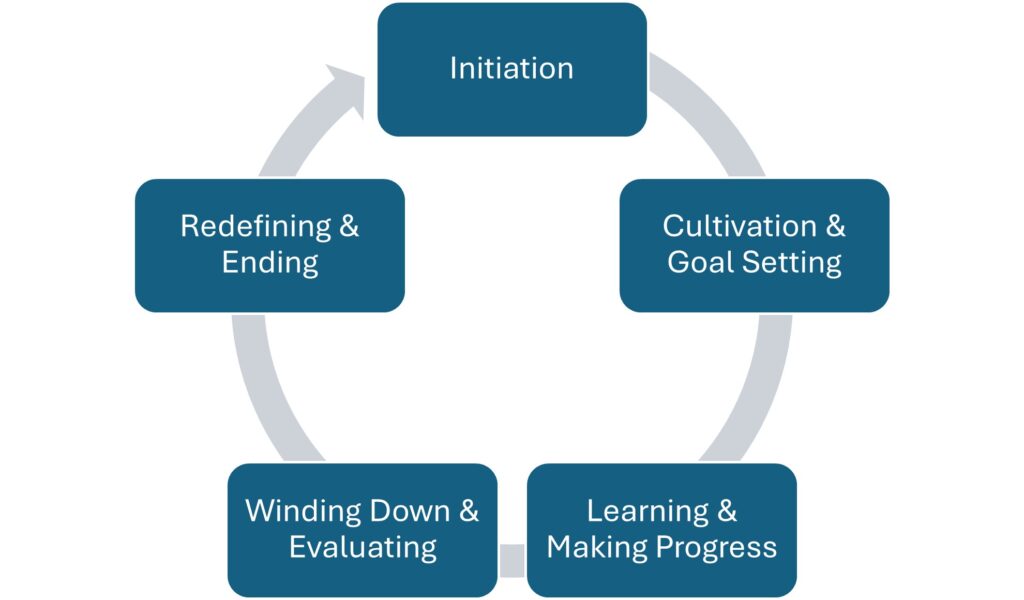
- Initiation Stage – This is the time to build rapport. Offer introductions and find areas of common ground, set and understand boundaries, determine the meeting schedule, and discuss the expectations for the other four stages including the ending date for the mentorship component.
- Cultivation & Goal Setting Stage – When the work begins. Review established goals by the mentee for the mentoring relationship. Identify resources needed for making progress, including professional development and training opportunities. Discuss the requirements for the final project and how the mentor can be of assistance as a key thought partner.
- Learning & Making Progress Stage – Typically this is the longest stage. Make progress on goals, address barriers experienced, and identify resources available. Discuss completion of the final project.
- Winding Down & Evaluating Stage – Recognize lessons learned through the mentorship process. Evaluate strategies for continuing to make progress on goals and options for seeking professional development after the mentoring relationship has ended.
- Redefine & End Stage – Formal closure of the mentorship relationship. Identify the options for continued communication in an informal professional relationship. Celebrate the progress made and craft ways to communicate future successes.